
At Sarbasiddhidham Panchkot in Baglung, a sacred water vessel is being built at the scale of a tower. The Vishwashanti Gandaki Kalash (विश्वशान्ति गण्डकी कलश) is planned as a 108-foot religious landmark, a symbol of world peace and a statement about the Gandaki River and the protection of water.
Its foundation stone was laid in 2071 BS (2014/15). It then stalled for years for lack of money, and construction picked up again under a federal multi-year programme.
The current work is funded at Rs 7 crore and preparations are under way to cast the third floor of a 13-storey concrete structure. This is not a statue or a giant decorative pot. It is a building whose outside will take the shape of a traditional Kalash, with a lift and interior rooms meant for religious activity. The full project is estimated to cost more than Rs 45 crore.
What is being built
The structure is planned as a 13-storey reinforced concrete building with a lift. Its exterior will be a Kalash and its interior will hold rooms for religious activities. The building would have 16 rooms for religious use.
The work is split in two. The federal government is paying for the exterior structure under a multi-year programme. The decorative and interior work will depend on donations and other contributions, alongside government help. The aim is to finish the exterior within the next two years.
Where Panchkot is and why it was chosen
Panchkot lies in Baglung Municipality-6, about seven kilometres north of Baglung Bazaar, in Gandaki Province. The Nepal Tourism Board lists Panchkot and the nearby Shaligram Museum as attractions, noting their religious value and views of the Annapurna and Dhaulagiri ranges.
The name means five forts, or kots. They are named as Tatajalkot, Karikot, Majhkot, Raynaraynakot and Sansaarkot. These are places linked to local kings and to shrines built to worship divine powers. The five places were brought together under the idea of Panchkot Dham, a single religious and tourism complex instead of separate shrines.
The wider vision goes beyond one monument. It includes a centre for Vedic and Sanatan Hindu activity, promotion of the Gandaki region's religious importance, pilgrims from Nepal and abroad, closer links between Baglung and the Muktinath pilgrimage corridor, and tourism jobs for nearby communities. Panchkot also serves as a shared destination for Adivasi, Janajati and Arya communities.
Who started it
Swami Kamalnayanacharya, popularly known as Muktinath Baba, conceived Panchkot Dham. He also founded Muktinath Peeth and has promoted the site as a religious and tourism centre.
The project began as a religious and institutional initiative, not a government works project. Support has come from religious organisations, donors, local communities and government bodies. The Akhanda Jyoti Baba Swami Sriji Charitable Trust, linked to the founder, has helped pay for infrastructure there.
In 2071 BS, then Prime Minister Sushil Koirala attended the foundation-laying for the Panchkot religious infrastructure, including the planned Kalash. The presence of a sitting prime minister gave the project national attention. Construction did not follow quickly, and the Kalash became one of the most delayed parts of the wider development.
Why a Kalash, and why 108
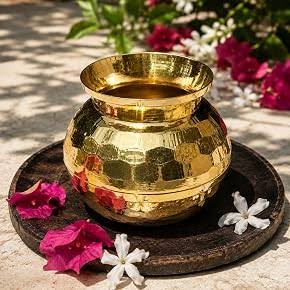
A Kalash is a sacred vessel, made of metal or clay, used in Hindu ceremonies. It is usually filled with water and decorated with leaves, flowers and a coconut. It stands for life, purity, fertility and renewal. In some interpretations it also holds the nectar of immortality, called Amrita.
It is also read as a model of the cosmos. According to the Hindu encyclopedia Hindupedia, its mouth is linked to Brahma, its neck to Rudra, its base to Vishnu and its middle part to Devi. Some traditions describe the vessel as holding the universe, with its seas, islands, planets and stars.
The number 108 is significant in several Hindu traditions. A japa mala, the string of prayer beads used to count mantras and divine names, commonly has 108 beads.
The project takes an object from household and temple worship and turns it into a structure that can be seen across the landscape. It will not be a giant functioning water vessel, only a building shaped like one.
From 2014 to 2026
2014-15. The foundation stone for the wider religious infrastructure, including the Kalash, was laid. Money was raised through religious events, donations and a Maha Yagya, a large fire ritual.
2019. The municipality recorded the ongoing development: the planned 108-foot urn, a Gandaki Mata temple, accommodation and other religious facilities.
January-March 2024. Kalash construction was at an early stage. A Brahmandiya Mahayagya ran from 19 February to 4 March 2024 to raise money for the Kalash and other religious structures. It also stressed the religious importance of Shaligram and the protection of Nepal's water resources.
22 February 2024. President Ram Chandra Paudel inaugurated the consecration of a 5,555-kilogram bell at Panchkot, the Muktinath Mahaghanta. It took eight years to make and cost about Rs 20 million.
It is made from five metals: gold, silver, copper, brass and iron. It became a main draw while the Kalash remained unfinished.
2025. The Department of Urban Development and Building Construction, through its Baglung project office, began procuring construction of the "Shree Bishwoshanti Gandaki Kalas" memorial structure. A recommendation notice on 7 May 2025 named the B.K. Sons-Dolpa Hirachan-Dolpo joint venture of Thulibheri-3, Dolpa, as first-ranked bidder, at Rs 51,326,375.22, or about Rs 5.13 crore.
19 April 2026. Construction was moving again after years of financial delay, with first-floor work under way.
23 November 2026. Work reached the stage of preparing to cast the third floor under the Rs 7 crore federal programme.
The reason given for the long delay is a shortage of money. The project depends on government assistance, donations from devotees and private contributors, Maha Yagya fundraising and contributions from religious institutions, and the main monument has moved at a different pace from the rest of the complex.
What it costs
Three figures circulate, and they cover different things:
• Rs 7 crore is the reported cost of the current federal construction programme, which mainly covers the exterior structure.
• Rs 45 crore or more is the estimated cost of completing the entire Kalash, including architectural finishing and interior work, according to the latest detailed project report (DPR).
• Rs 5.13 crore was the quoted bid of the recommended construction bidder in 2025.
In January 2024, the Panchkot Dham chairperson told that the Kalash would cost around Rs 4 crore, so the estimate has changed sharply.
The Gandaki connection
The word Gandaki ties the monument to the river and to the religious heritage of the Gandaki region. The Kali Gandaki is closely linked to Shaligram, the ammonite fossils found along its corridor. Shaligrams hold special importance in Hindu worship, particularly in traditions linked to Vishnu. A June 2026 report said the Shaligram Museum near Panchkot houses about 115,000 Shaligram fossils in a 150-metre tunnel.
The project's organisers say the Kalash is meant to communicate the importance of protecting water resources, and to represent the forms of rivers and water and the Gandaki civilisation. The 2024 Brahmandiya Mahayagya also included a campaign to preserve Nepal's water resources.
The setting raises a question about practice. A September 2023 investigation reported that illegal extraction of sand and stone continued along the Kali Gandaki despite a Supreme Court ban on riverbed excavation, with weak monitoring and enforcement by local authorities. Building the Kalash is not shown to have caused this.
What already stands at Panchkot
The Kalash is one part of a larger complex, which already gives visitors reasons to come.
• Muktinath Mahaghanta: the 5,555-kilogram bell described above.
• Gandaki Mata Temple: a shrine dedicated to Gandaki Mata that ties the complex to the river's sacred traditions.
• Shish Mahal: a glass-decorated attraction.
• Hanuman and Garuda structures: large religious sculptures.
• Accommodation: a three-storey residential building, with spaces for religious gatherings.
• Other facilities: a Yagyashala (hall for fire rituals), Havan Kunda, Hanuman Batika, Gandaki Gopal Gaushala, pathways and a large gathering hall.
Tourism hopes
Panchkot is being built up as a religious-tourism destination in western Nepal. The audiences include domestic pilgrims, Indian pilgrims heading to Muktinath, Pashupatinath and other sacred sites, visitors interested in Shaligram, religious architecture and local history, and general tourists drawn by the mountain views.
The Muktinath link is central. Indian pilgrims travelling the Kaligandaki corridor from Bhairahawa to Muktinath were increasingly stopping in Baglung to visit places including Panchkot and the Shaligram Museum. Local stakeholders hope Panchkot can become a gateway to Muktinath. Baglung already has other attractions, including the Baglung Kalika Temple, Dhorpatan, suspension bridges and mountain viewpoints.
The benefits the project's backers expect are more demand for hotels and restaurants, jobs, more transport business, outlets for local farmers and producers, more investment in tourism facilities and greater visibility for Baglung.
What this means for Nepali abroad
Panchkot's backers aim at pilgrims from India and at Hindu visitors generally, and Nepalis abroad who travel home for Dashain or Tihar could include Baglung in a Muktinath trip. Visitors should expect an unfinished site: the exterior is not due to be finished for about two years, and the interior and decoration depend on donations.
What comes next
The exterior is meant to be done in about two years. A faith monument conceived more than a decade ago has now reached its third floor. Its meaning will depend on whether the money, the building and the conservation message all follow through.


